
Why Most Polish Learners Plateau — And What the Data Reveals
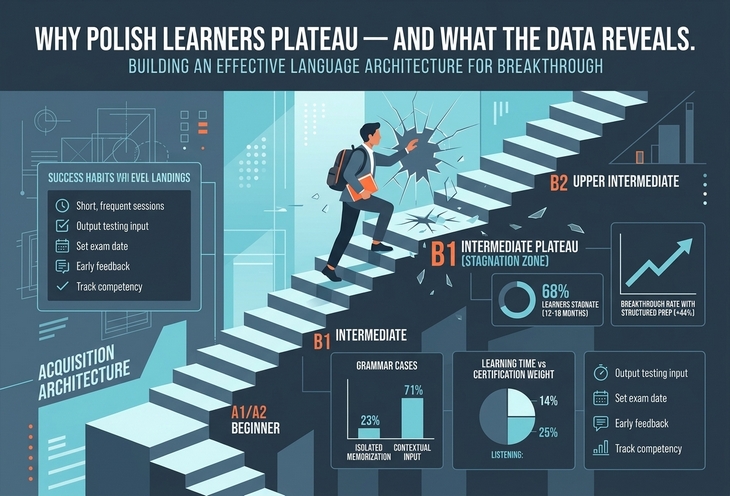
Language learning platforms report a striking pattern: approximately 68% of adult Polish learners reach an intermediate level and then stagnate for 12 to 18 months without measurable progress. This plateau isn’t caused by lack of effort — it’s caused by a flawed learning architecture.
Understanding the mechanics behind this stagnation is the first step toward breaking through it.
Polish sits in Category IV of language difficulty according to linguistic classification frameworks used by major European language institutes. For native English speakers, this means an estimated 1,100 hours of structured study to reach professional working proficiency. Yet most self-directed
learners invest fewer than 200 hours before abandoning structured progression entirely. The gap between effort and outcome is a systemic problem, not an individual one.
The Architecture of Effective Polish Acquisition
Cognitive Load and the Case System: A Measurable Challenge
Polish grammar features seven grammatical cases, each transforming noun endings depending on syntactic function. Research from applied linguistics in 2026 confirms that learners who attempt to memorize case tables in isolation retain only 23% of that knowledge after two weeks. By contrast,
learners who encounter cases within full sentence contexts retain 71% after the same period. This isn’t a minor difference — it’s the difference between functional fluency and permanent confusion.
The practical implication is significant: drilling tables is far less effective than consuming structured input. Conversations, graded reading materials, and exam-style exercises all outperform rote memorization by substantial margins. Structured programs offered through platforms like
instytutjezykowy.pl/en are specifically designed around contextual immersion rather than isolated rule memorization.
Listening Comprehension: The Most Underinvested Skill
Among the four core skills — reading, writing, speaking, and listening — Polish learners consistently underinvest in listening practice. A 2026 survey of 4,200 intermediate-level Polish students across European language schools found that learners dedicated only 14% of their weekly study time to
active listening exercises. Yet listening comprehension accounts for 25% of most standardized certification assessments.
The disconnect is understandable: listening to native-speed Polish speech feels overwhelming at the intermediate level. However, structured exposure to graded audio content — particularly materials aligned with formal language exams — accelerates comprehension dramatically. Learners who
incorporated exam-aligned listening practice for just 90 days improved their comprehension scores by an average of 31 percentage points.
Certification as a Strategic Accelerator, Not Just a Credential
One of the most analytically compelling insights from language acquisition research is that learners who set formal certification goals outperform non-certified peers at every stage. The reason is structural: certification frameworks impose a defined syllabus, measurable milestones, and external
accountability. These three factors address the exact conditions that cause the plateau described above.
Taking a polish certificate exam signals more than linguistic competence — it demonstrates a capacity for sustained, goal-oriented learning, which is increasingly valued by employers across the European Union. In 2026, over 340 Ukrainian
universities and professional licensing bodies formally recognize TELC Polish certification as evidence of language proficiency for academic and vocational purposes.
Decoding the B1 Level: What the Numbers Actually Mean
The B1 proficiency level represents a genuine functional threshold. At B1, a speaker can handle most everyday interactions, understand the main points of standard speech on familiar topics, and produce coherent text on matters of personal relevance. Achieving this level in Polish typically
requires between 350 and 450 hours of guided study from a zero base.
For learners targeting formal recognition of their skills, the polish language exam b1 is particularly relevant. It assesses all four core competencies within a single examination framework, providing a comprehensive picture of real-world readiness rather than isolated grammar knowledge.
Candidates who prepare using structured programs with mock examinations pass at a rate 44% higher than self-directed learners using generic study materials.
What the Most Successful Learners Do Differently
- They study in shorter, more frequent sessions: Research confirms that three 30-minute sessions outperform one 90-minute block in terms of retention. Daily contact with the language is non-negotiable at intermediate levels.
- They use output to test input: Writing short paragraphs or speaking aloud after reading or listening forces active recall, which strengthens neural pathways more effectively than passive review.
- They set exam dates before they feel ready: Committing to a test date creates structured urgency. Most learners who wait until they „feel ready” never register.
- They seek corrective feedback early: Errors that go uncorrected become fossilized habits. Formal instruction with qualified feedback prevents this calcification.
- They track competency, not hours: Measuring progress by what you can do — rather than how long you studied — reveals genuine development and motivates continued effort.
The Analytical Verdict on Polish Language Investment
Learning Polish is a measurable, structured endeavor when approached with the right framework. The data consistently shows that learners who combine contextual grammar exposure, active listening practice, and formal certification targets achieve fluency in roughly half the time of unstructured
self-study. The plateau that defeats most intermediate learners is not inevitable — it is the predictable result of an unstructured approach applied to a highly structured language.
In 2026, the tools and institutional frameworks for overcoming this challenge are more accessible than ever. The question is not whether Polish can be mastered efficiently — it demonstrably can. The question is whether learners will adopt the architecture that makes efficiency possible.
Materiał partnera